

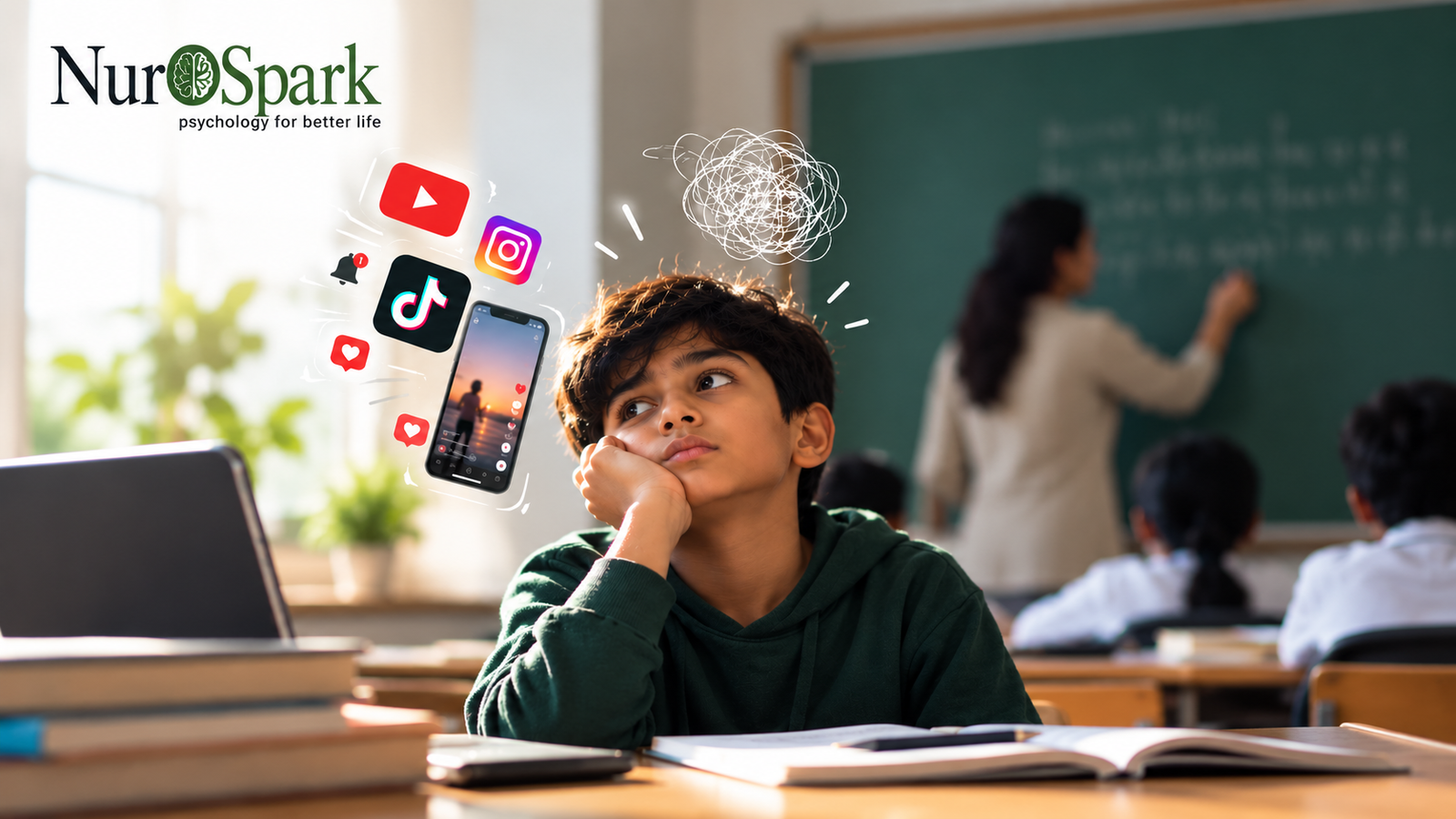
Are Students Losing Their Ability to Focus? What Psychology Tells Us About Attention in the Age of Reels, AI and Instant Gratification
NuroSpark | Psychology in Current Affairs | October 2026
A student opens a textbook.
Within a few minutes, the temptation appears: check the phone, open Instagram, watch one reel, reply to a notification, search something online—or ask AI for an immediate answer.
Then the student returns to the textbook.
For many parents and teachers, this pattern has become increasingly familiar. It raises an important question:
Are children and young adults actually becoming less capable of concentrating, or has the environment in which attention operates fundamentally changed?
A recent report on Indian classrooms has brought this question into focus.
What the Recent News Says
On 2 October 2026, The Times of India reported on growing concerns about instant gratification and reduced sustained attention in Indian classrooms.
According to the report, a nationwide survey by the National Council of CBSE Schools involving approximately 6.3 lakh teachers, students under 18 and parents found that almost 70% of teachers reported observing a sharp decline in students' focus and classroom attention.
The survey also reported that 74% of students spend more than two hours per day on screens for non-academic purposes. The Times of India
These findings should not be interpreted to mean that a phone automatically “destroys” a child's attention span. They do, however, raise an important psychological question about the environment in which attention, motivation and self-regulation are developing.
The Psychology Behind the Problem
Human attention has always been selective.
Our brains cannot process everything around us with equal priority. We constantly decide—often automatically—what deserves attention and what can be ignored.
Digital environments have introduced something unusual into this system: an enormous supply of rapid, novel and immediately rewarding stimuli.
Consider the difference.
Traditional studying may require a learner to read several pages before understanding an idea.
- A short-video platform can provide something new every few seconds.
- A difficult mathematics problem may require sustained effort before producing satisfaction.
- A notification can provide immediate social feedback.
- A long lecture requires the learner to maintain attention.
- A digital feed changes automatically with a single swipe.
This difference matters because behaviour is influenced by reinforcement and reward.
The “Swipe → Reward → Again” Loop
Recent research reported from PGIMER Chandigarh provides an interesting example.
A study involving 119 young respondents—77% of whom were college students aged 18–24—examined how platform design may influence everyday behaviour.
Researchers highlighted an important difference between older forms of media and modern algorithmic platforms.
- A television programme eventually ends.
- A newspaper has a final page.
- A chapter reaches its conclusion.
But an infinite social-media feed has no natural stopping point.
The researchers described a behavioural cycle in which swiping may lead to an unpredictable reward—a funny video, interesting story, attractive image or emotionally stimulating piece of content—which encourages another swipe.
In simple terms:
Swipe → Reward → Swipe Again
Because the reward is not identical every time, the uncertainty itself can help sustain checking behaviour. The study also discussed boredom and notifications as cues that may trigger this cycle. The Times of India
This connects directly with a foundational concept in behavioural psychology: reinforcement.
When behaviour repeatedly produces rewarding outcomes, the probability of repeating that behaviour can increase.
Why Studying Can Feel “Too Slow”
Now imagine moving directly from 30 minutes of short-form video to reading a psychology textbook.
The contrast is enormous.
On the phone:
Swipe → Novelty → Reward → Swipe → Novelty → Reward
During studying:
Read → Think → Understand → Practise → Make mistakes → Continue → Eventually master the concept
The second process requires something psychologically important:
Delayed gratification.
The reward does not necessarily arrive immediately.
A learner may have to tolerate confusion, boredom or difficulty before experiencing achievement.
Therefore, the challenge may not simply be:
“Students don't want to study anymore.”
A more useful psychological question is:
“What kinds of rewards and stimulation has the learner become accustomed to receiving?”
Attention Is Not Simply an On/Off Switch
This is particularly important for parents, teachers and counsellors.
A child may struggle to complete 30 minutes of homework but spend a long period playing a game, watching videos or working on something personally interesting.
Adults sometimes conclude:
“If you can concentrate on your game, you can concentrate on your studies. You're just being lazy.”
Psychology requires a more careful interpretation.
Attention is affected by multiple factors, including interest, novelty, task difficulty, motivation, environmental distractions, fatigue, emotional state, immediate feedback and the structure of the task.
Therefore, the better question is not simply:
“Can this person concentrate?”
It is:
“Under what conditions does concentration become easier or harder?”
That question can reveal much more about behaviour.
We Should Be Careful Not to Turn Every Attention Problem Into ADHD
This distinction is especially important today.
Difficulty concentrating does not automatically mean ADHD.
Attention difficulties can occur alongside sleep problems, stress, anxiety, learning difficulties, environmental distractions, excessive digital engagement, developmental factors and other psychological or medical concerns.
Likewise, a child who frequently uses digital media should not automatically be assumed to have developed an attention disorder.
Behaviour should be understood in context.
For counsellors and psychology learners, a useful framework is:
Frequency → Intensity → Duration → Context → Functional Impact
Instead of asking only whether a behaviour exists, examine how frequently it occurs, how intense it is, how long it has persisted, where it occurs and whether it meaningfully interferes with daily functioning.
Screen Time Alone Doesn't Tell the Whole Story
Another important point is that psychology should avoid simplistic conclusions such as:
“All screen time is bad.”
A 2026 study of 600 students in Indian higher education distinguished between academic and non-academic digital engagement and argued that the effects of screen use depend on more than duration alone.
The researchers emphasized factors including what the screen is being used for, the purpose of engagement and the nature of the digital activity. Springer
A student spending two hours attending an interactive online psychology class is not necessarily having the same psychological experience as someone spending two hours continuously scrolling short-form entertainment.
So the better discussion is not:
Screen vs no screen.
It is:
Intentional digital use vs uncontrolled digital consumption.
What Can Parents Do?
Simply confiscating the phone may address access without teaching self-regulation.
A more sustainable goal is helping children gradually develop the ability to manage attention themselves.
Parents can create predictable periods for study, sleep, recreation and device use; reduce unnecessary notifications during focused activities; model healthy phone behaviour themselves; encourage physical activity, hobbies and face-to-face interaction; and avoid turning every moment of boredom into digital entertainment.
The PGIMER research also highlighted replacing screen use with activities such as sports and hobbies as one strategy for reducing excessive use. The Times of India
Children sometimes need opportunities to experience boredom without immediately escaping it.
That uncomfortable moment may be where creativity, exploration and self-directed activity begin.
What Can Teachers Do?
The answer is not necessarily to make every 60-second segment of education as stimulating as a reel.
Education cannot—and probably should not—compete with entertainment purely on stimulation.
But teaching can become more psychologically informed.
For example:
Explain → Ask → Discuss → Apply → Reflect
Instead of relying exclusively on long passive lectures, educators can incorporate questioning, case studies, experiential activities, discussion, retrieval practice, demonstrations and opportunities to apply concepts.
The recent reporting from Indian schools describes educators increasingly experimenting with more interactive and student-centred approaches in response to changing attention patterns. The Times of India
The goal should not be endless entertainment.
The goal should be meaningful cognitive engagement.
What Should Counsellors Look For?
A counsellor should resist immediately blaming either the child or the smartphone.
Instead, investigate the behavioural environment.
Ask:
- When does the attention problem occur?
- When does it not occur?
- What happens immediately before the child becomes distracted?
- What happens immediately afterward?
- How much sleep is the child getting?
- What is their digital routine?
- Is the academic work appropriate to their developmental and learning level?
- Are anxiety, stress or emotional difficulties present?
- Is the same pattern visible at home, school and other settings?
- How is the difficulty affecting academic, social and everyday functioning?
This moves the conversation from judgement to case formulation.
The Bigger Psychological Question
- Technology itself is not the only issue.
- The larger transformation may be the changing psychology of expectation.
- Food can arrive quickly.
- Entertainment begins instantly.
- Messages receive immediate responses.
- Search engines provide information in seconds.
- AI can generate answers almost immediately.
- Yet many important human achievements still operate according to an older psychological timetable.
- Learning takes time.
- Relationships take time.
- Expertise takes time.
- Behaviour change takes time.
- Careers take time.
- Therapy takes time.
- Personal development takes time.
Our external environment may increasingly provide instant rewards, while many of the things that matter most still require patience, repetition, frustration tolerance and delayed gratification.
That tension deserves serious psychological attention.
The NuroSpark Perspective
At NuroSpark, we believe psychology becomes most valuable when learners can connect theories with behaviours happening around them.
The conversation about children's attention should therefore move beyond:
“Phones are bad.”
It should also move beyond:
“This generation simply cannot concentrate.”
Instead, psychology encourages us to ask:
What is shaping this behaviour?
What is reinforcing it?
What environmental conditions maintain it?
What developmental factors should we consider?
And how can we help individuals develop healthier self-regulation rather than simply controlling them?
Perhaps the most important lesson is this:
Before labelling behaviour, understand the environment that is shaping it.
That is where psychology moves from textbook knowledge to understanding real human behaviour.
.jpg)
.jpg)
.jpg)
.jpg)

.jpeg)




.jpeg)

.jpeg)






.jpg)
.jpg)
.jpg)
.jpg)

.jpg)
.jpg)
.jpg)
.jpg)
.jpg)
.jpg)