
Delhi High Court Verdict Brings Major Relief to Psychology Students Across India
A Turning Point for Psychology Education and Career Pathways
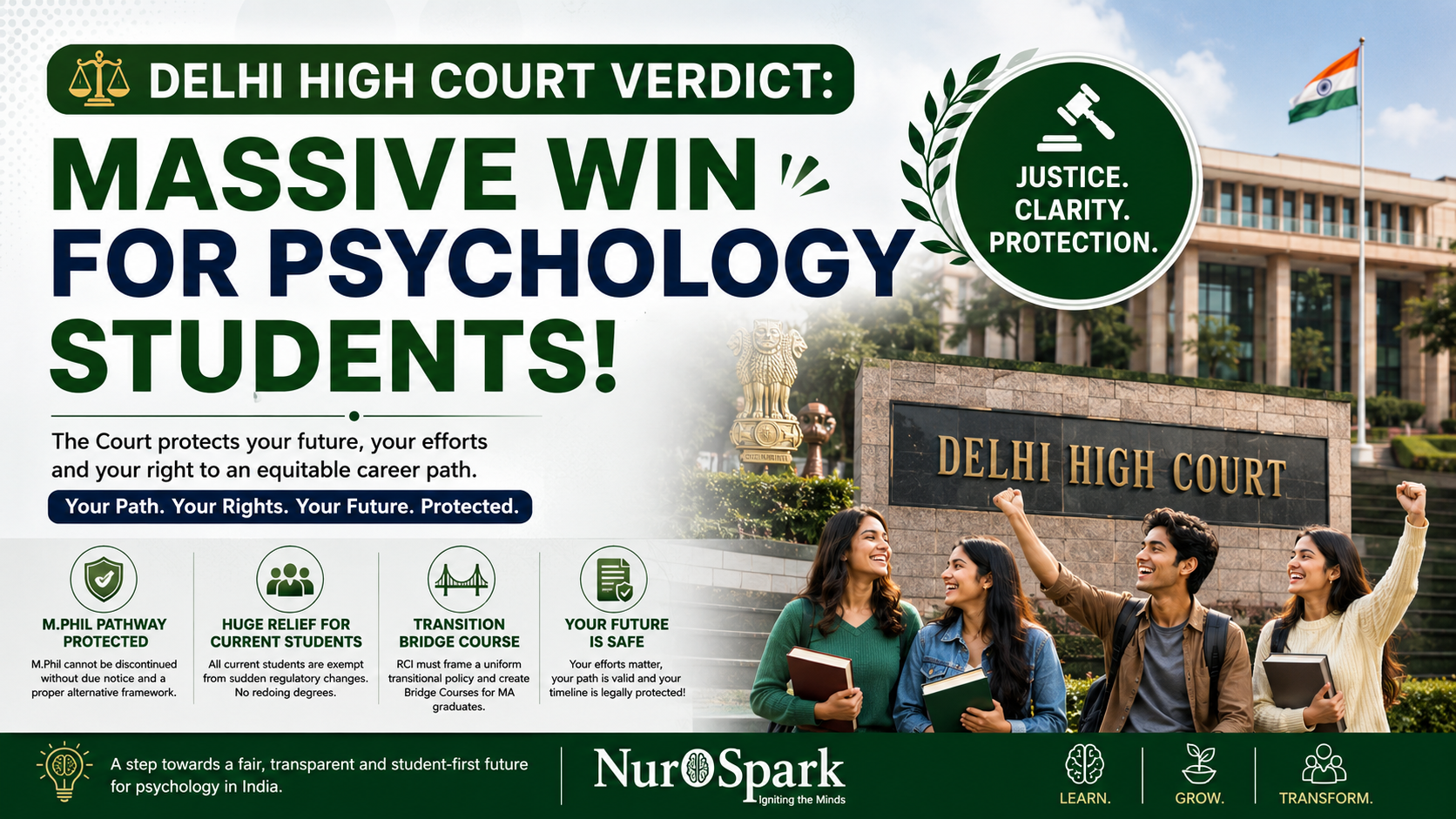
The field of psychology in India has witnessed significant confusion and uncertainty over the past few years, especially surrounding the discontinuation of the M.Phil in Clinical Psychology pathway by the Rehabilitation Council of India (RCI). Thousands of psychology students found themselves uncertain about their future, career timelines, and professional eligibility. However, a recent Delhi High Court verdict has now brought major relief and clarity to students pursuing careers in psychology.
The court's decision is being viewed as an important moment for psychology education in India because it protects the interests of current students while emphasizing the need for a proper transition framework before implementing major regulatory changes.
What Was the Main Issue?
Traditionally, many students in India followed this pathway to enter Clinical Psychology:
BA/BSc Psychology → MA/MSc Psychology → M.Phil Clinical Psychology
The M.Phil in Clinical Psychology was widely considered one of the most important professional pathways for students aspiring to work toward becoming RCI-recognized Clinical Psychologists.
However, with the implementation of the National Education Policy (NEP) 2020, changes began taking place in higher education structures across India. As part of this transition, the RCI started discontinuing the M.Phil pathway without a clear and well-structured transition system for existing students.
This created massive confusion among psychology aspirants.
Students became concerned about:
Sudden changes in eligibility structures
Longer academic pathways
Uncertainty regarding future registration
Duplication of degrees
Additional years of education
Career delays and financial burden
For many students, years of planning suddenly appeared unstable.
What Did the Delhi High Court Say?
The Delhi High Court strongly emphasized that students cannot be negatively affected due to abrupt policy changes without proper transition support.
The court observed that major academic pathways cannot simply be removed overnight without considering the future of students who have already planned or begun their educational journeys under existing systems.
The verdict reportedly provided relief in several important areas.
Protection for Existing Students
One of the biggest reliefs from the judgment is that students already pursuing psychology education under the earlier system are protected.
This means students currently studying:
- BA Psychology
- BSc Psychology
- MA Psychology
- MSc Psychology
should not suddenly be forced into unfair academic restructuring or additional unnecessary degrees due to abrupt regulatory changes.
The judgment has reassured students that their educational journey and career plans remain valid.
M.Phil Pathway Cannot Be Abruptly Removed
The court also highlighted that discontinuing the M.Phil pathway without a proper alternative framework and transition plan is problematic.
It emphasized the need for:
- Proper notice
- Structured transition
- Clarity in eligibility
- Fair treatment of existing students
This is extremely important because many psychology students had already invested years into preparing for this pathway.
Transition and Bridge Courses May Be Introduced
Another major outcome discussed in the judgment is the possibility of structured transition or bridge mechanisms.
This could help reduce confusion between:
UGC degree structures
RCI eligibility requirements
Old and new educational frameworks
For many students, this could prevent unnecessary duplication of academic years and create smoother transitions toward professional registration pathways.
Why This Matters for Psychology Students
The psychology field in India is currently undergoing rapid growth and transformation.
- Awareness regarding:
- Mental health
- Emotional well-being
- Counselling
- Child psychology
- Human behaviour
- Emotional intelligence
- has increased significantly in recent years.
As more students enter the field, clarity about career pathways becomes increasingly important.
This judgment provides psychological and academic relief to thousands of students who were worried about whether their existing academic journey would become invalid or unnecessarily extended.
Psychology Is Growing Beyond Traditional Boundaries
One important aspect highlighted by recent discussions is that psychology is no longer limited only to clinical settings.
Today, psychology is being applied in:
- Education
- Corporate leadership
- Human resources
- Child development
- Coaching
- Parenting
- Relationship guidance
- Workplace well-being
- Personal growth
- Emotional intelligence training
Globally, psychology is increasingly being viewed not only as a profession but also as an important life skill.
Countries such as the USA, UK, Canada, and Australia have already integrated psychology learning into broader educational and professional ecosystems where people from multiple backgrounds study psychology to better understand human behaviour, communication, emotions, and relationships.
What This Means for Learners and Educational Platforms
The recent developments also show that psychology students today need:
- Better career guidance
- Clear pathway explanations
- Ethical learning environments
- Practical exposure
- Foundational understanding of psychology
- Many learners are now seeking psychology education not only to pursue clinical careers, but also to:
- Understand themselves better
- Improve communication skills
- Become emotionally aware
- Build helping skills
- Support their families
- Explore future psychology pathways
This creates a growing demand for responsible psychology education platforms that can simplify psychological concepts while maintaining ethical clarity.
The Importance of Ethical Psychology Education
While psychology education is becoming more accessible, it is equally important to distinguish between:
Learning Psychology
and
Practicing Psychology Professionally
Professional clinical practice requires advanced training, supervision, and regulatory compliance depending on the field and role.
However, foundational psychology education can still play an important role in:
- Personal development
- Communication skills
- Emotional intelligence
- Human understanding
- Career exploration
Responsible educational institutions must communicate these distinctions clearly while encouraging ethical and continuous learning.
A Positive Moment for the Psychology Community
Despite the confusion created over the past few years, the Delhi High Court verdict has brought a sense of stability and reassurance to psychology students across India.
The judgment sends an important message:
Students should not suffer because of abrupt regulatory uncertainty.
At the same time, the growing conversations around psychology demonstrate how rapidly the field is evolving in India.
Mental health awareness is increasing.
Psychology education is expanding.
Students are actively exploring the field.
Society is becoming more aware of emotional well-being and human behaviour.
All of this indicates that psychology will continue playing a major role in the future of education, healthcare, workplaces, and society.
Final Thoughts
The Delhi High Court verdict is not just a legal development—it is a reflection of the growing importance of psychology education in India.
For students, it offers relief and reassurance.
For the psychology community, it highlights the need for clearer educational pathways.
And for society, it reinforces an important truth:
Understanding human behaviour, emotions, and mental well-being has never been more important than it is today.
As the field continues evolving, learners will increasingly need institutions, mentors, and platforms that provide clarity, ethical guidance, practical learning, and responsible psychology education.
The future of psychology in India is growing—and this judgment may become one of the important milestones shaping that journey.
About NuroSpark
NuroSpark is a psychology-powered learning platform dedicated to making psychology practical, accessible, and transformative for learners from all backgrounds. Through live interactive learning, practical exercises, case discussions, and structured programs, NuroSpark helps individuals understand human behaviour, emotional intelligence, communication, and personal growth.
🧠 Learn. Grow. Transform.


.jpg)

.jpeg)




.jpeg)

.jpeg)






.jpg)
.jpg)
.jpg)
.jpg)

.jpg)
.jpg)
.jpg)
.jpg)
.jpg)
.jpg)